
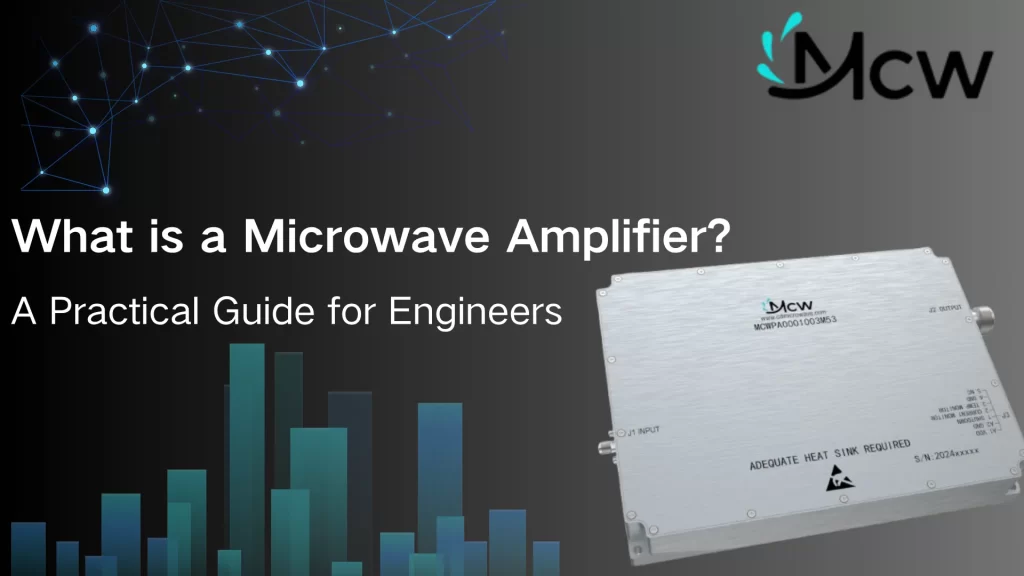
A microwave amplifier is an active electronic device designed to increase the power level of a high-frequency radio frequency (RF) signal. While traditional “microwave” frequencies strictly begin around 1 GHz, modern RF engineering often requires continuous signal amplification starting from the lower Megahertz (MHz) range deep into the Gigahertz (GHz) spectrum. Its primary function is to consume direct current (DC) power to generate a significantly stronger output signal, all while preserving the original waveform’s precise phase and frequency characteristics.
Think of a microwave amplifier as a high-performance industrial water pump. Imagine you have a very weak stream of water (the low-power input signal) carrying a specific rhythmic pulse. A massive water pump (the amplifier) uses electricity from the grid to drastically increase the pressure and volume of the water flow. The amplified water stream is now powerful enough to be shot across a vast distance, yet it still maintains the exact same rhythmic pulse as the original weak stream.
Technical Specs & Engineering Support
Need complete electrical parameters, S-parameter data, or custom RF design support for this series?
In high-reliability engineering environments, utilizing a sub-standard microwave amplifier can lead to catastrophic system-level failures:
- Catastrophic Burnout from Signal Reflection: In high-power applications, if the load (such as an antenna or a test chamber) is mismatched, the RF energy reflects back into the amplifier. Without robust Voltage Standing Wave Ratio (VSWR) protection, this reflected energy will instantly overheat and permanently destroy the internal transistors.
- Severe Signal Distortion: If the amplifier lacks strict linearity, it will introduce intermodulation distortion. In transmission systems, this acts like overlapping voices in a crowded room, causing severe data corruption and dropped communication links.
- System “Blindness” and Range Collapse: A sudden drop in output power or gain flatness means the transmitted signal cannot overcome free-space path loss. This results in the system going “blind”—drastically shortening the operational range or causing a complete failure in generating the required field strengths for laboratory testing.
To prevent these critical failures, Chengdu Microwave (Mcw) ensures every amplifier undergoes rigorous limit testing. Across our extensive product portfolio, our Solid State Power Amplifiers (SSPA) cover frequencies from 1MHz to 26.5GHz. Built with Class AB architecture and comprehensive built-in protection circuits (against over-temperature, over-current, and load mismatch), Mcw amplifiers provide an exceptional reliability margin for the most demanding environments.
Frequently Asked Questions (FAQ)
Q1: What is the difference between broadband and narrowband microwave amplifiers?
A narrowband amplifier is optimized to deliver peak efficiency and gain over a very specific, limited frequency range. A broadband amplifier, however, provides consistent amplification across a massive frequency spectrum, making it highly versatile for sweeping tests and multi-band systems.
Q2: Why is GaN (Gallium Nitride) widely used in modern microwave amplifiers?
GaN technology offers a unique combination of high power density, excellent thermal conductivity, and broad frequency capability. This allows for amplifiers that are physically smaller but output significantly more continuous power. This is exactly why Mcw integrates state-of-the-art GaN and GaAs technology into our high-power amplifier series, ensuring maximum thermal stability.
Q3: How is a microwave amplifier protected from damage?
High-quality amplifiers incorporate internal sensing circuits that constantly monitor temperature, current, and reflected power (VSWR). If a dangerous threshold is reached, the protection circuit will automatically reduce power or shut down the module.
Specializing in microwave and millimeter-wave active components, Chengdu Microwave (Mcw) delivers compact, high-performance amplifier modules ideal for test and measurement, communication, and complex RF systems. Contact our engineering team at [email protected].